Project

Microplastics in the Classroom: A Microscopic Investigation with Macroscopic Effects on Student Engagement

Intro

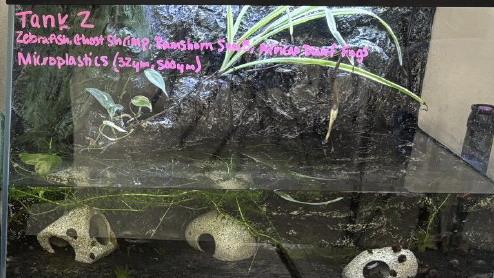
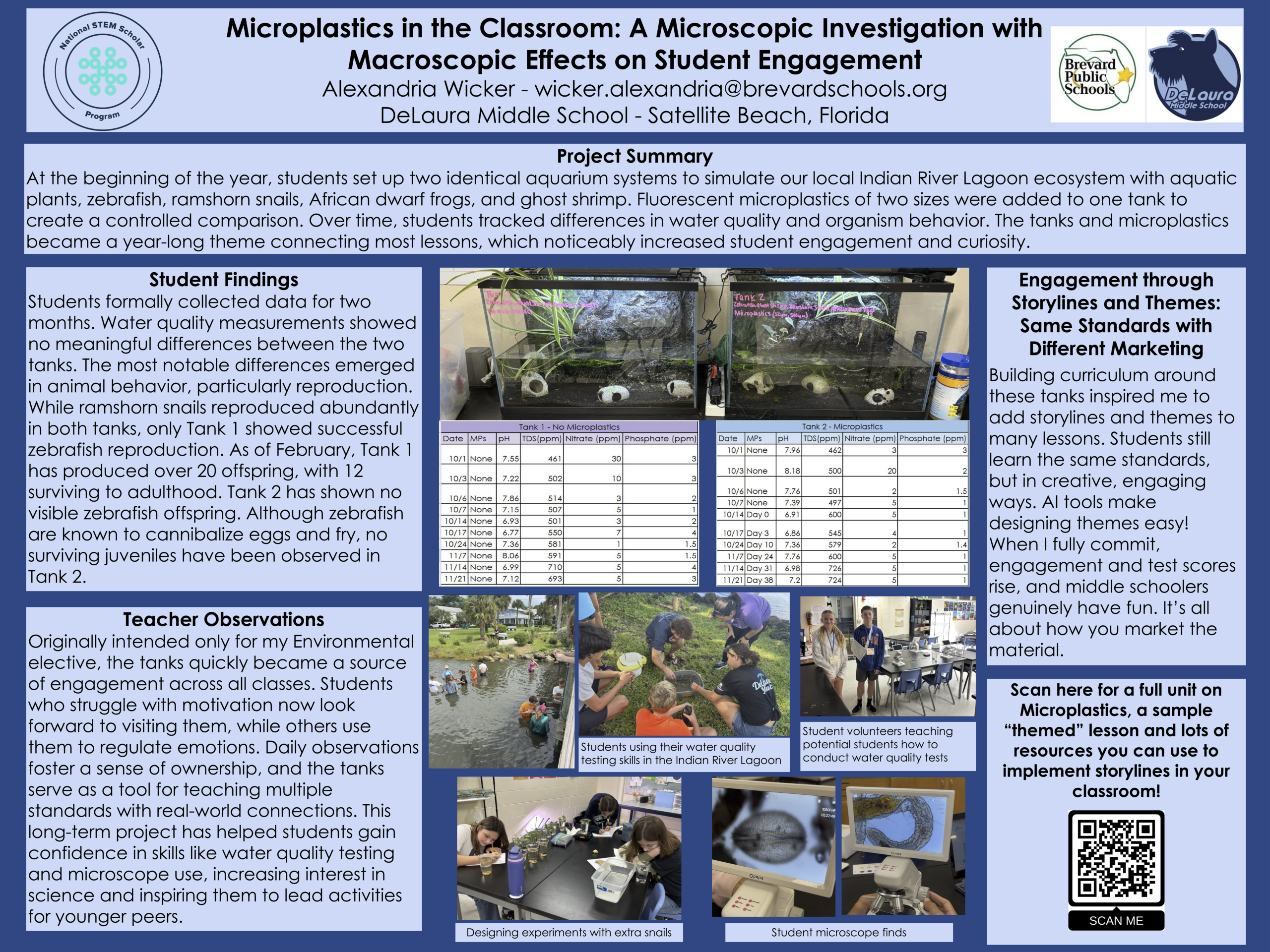
Students build two identical aquarium ecosystems modeled on Florida’s Indian River Lagoon, then add fluorescent microplastics to one tank to create a controlled experiment. Over the school year, they monitor water quality and organism behavior, discovering that while water chemistry stayed similar, zebrafish reproduced successfully only in the tank without microplastics. The tanks become a year-long storyline that connects lessons across the curriculum and builds student confidence in water testing, microscopy, and field research in the lagoon itself.

Science Domains: Earth & Space Sciences, Life Science

NGSS Standards: MS-ESS3-3, MS-LS1-5, MS-LS2-1, MS-LS2-4
Project Poster

Download the project poster as a PDF. The project poster includes a description of the challenge, learning goals, and a list of materials and references.

Download The Poster (PDF)

Learning Objectives

Students will be able to:

  • Design and maintain a controlled experiment comparing an ecosystem with and without microplastics.
  • Collect and analyze water-quality and behavioral data to identify how microplastics affect organisms.
  • Construct an evidence-based argument explaining how a human-introduced pollutant can affect population growth and reproduction.
  • Apply water-quality testing skills in a real estuary and teach those skills to younger peers.