Project

Solar STEM Festival

Intro

Seventh and eighth graders spend a school year making the Sun their central phenomenon. Using telescopes, they track the paths of the Sun and Moon to find cycles such as the seasons and moon phases. They use that data to predict sunrise, sunset, and eclipses, and they study how the Sun’s structure relates to light, energy, and matter. Everything comes together at the Solar STEM Festival, where students teach K–6 classmates on the day of the April 8, 2024 solar eclipse.

Science Domains: Earth & Space Sciences, Life Science

NGSS Standards: MS-ESS1, MS-ESS2, MS-LS2, MS-PS1, MS-PS2, MS-PS3, MS-PS4
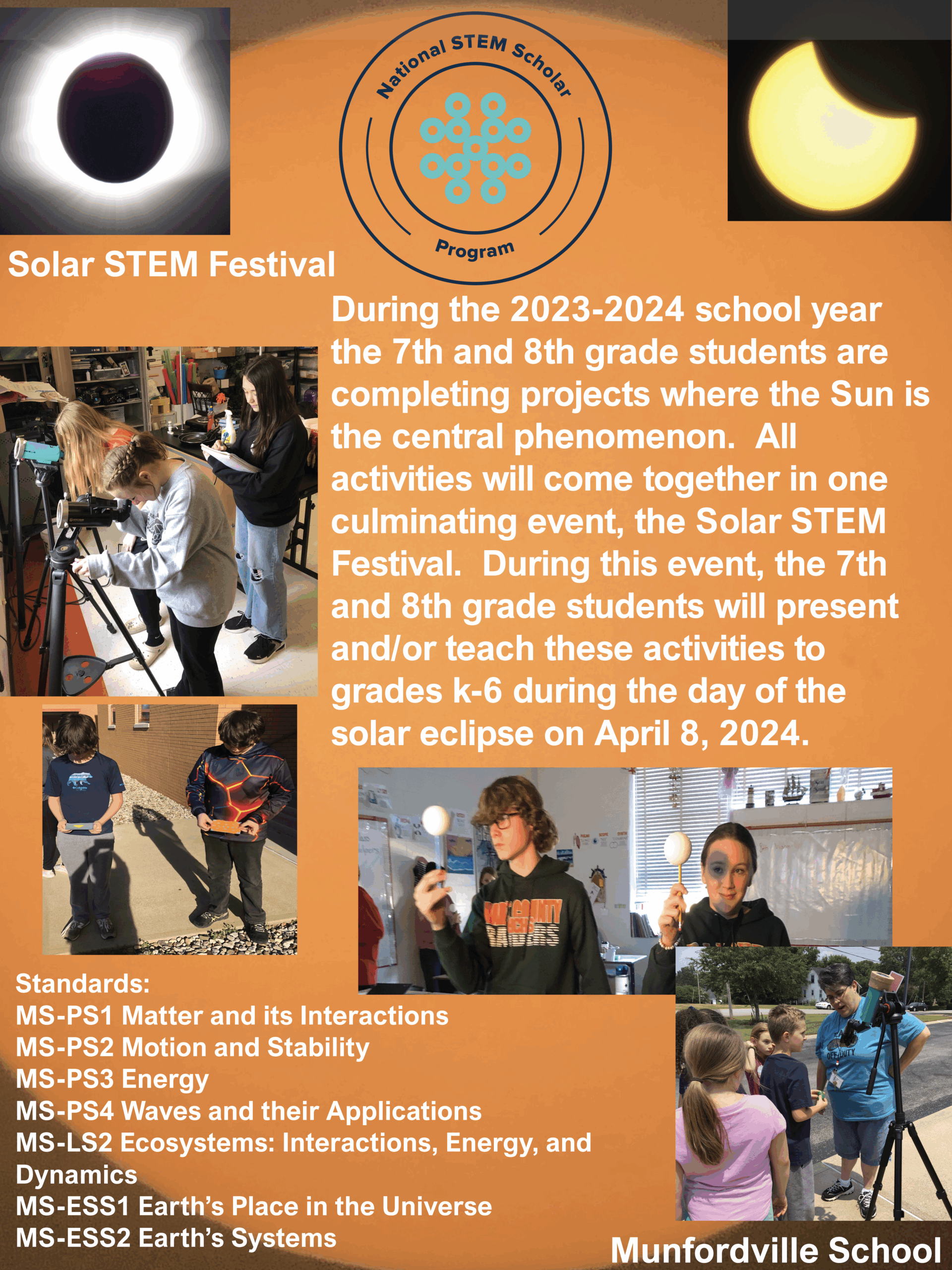
Project Poster

Download the project poster as a PDF. The project poster includes a description of the challenge, learning goals, and a list of materials and references.

Download The Poster (PDF)

Learning Objectives

Students will be able to:

  • Collect and plot data on the positions of the Sun and Moon over time.
  • Use models to explain moon phases, eclipses, and seasons.
  • Predict sunrise, sunset, and eclipse events from patterns in their data.
  • Describe the Sun’s structure and how it transfers light and energy.
  • Teach scientific concepts to younger students.

Project Materials

Solar telescopes with tripods, solar viewing glasses, UV-sensitive beads, foam balls on sticks and lamps for moon phase models, data journals.