
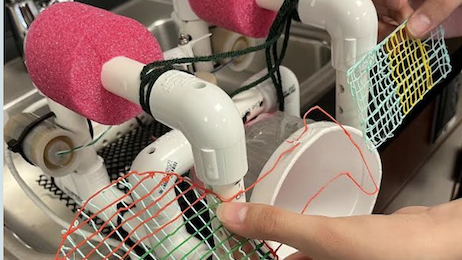
Students use SeaPerch, an underwater robotics program, to design and modify a remotely operated vehicle that targets, retrieves, and sorts aquatic debris such as plastic, aluminum, and iron. Applying concepts of density, magnetism, and filtration, students test and refine their designs in simulated underwater environments. Recovered materials become a collaborative recycled art installation, and students reflect on water conservation and the ethical impact of engineering decisions through literature, film, and writing.
Science Domains: Earth & Space Sciences, Engineering, Technology & Applications of Science, Physical Science
NGSS Standards: MS-ESS3-3, MS-ETS 1-3

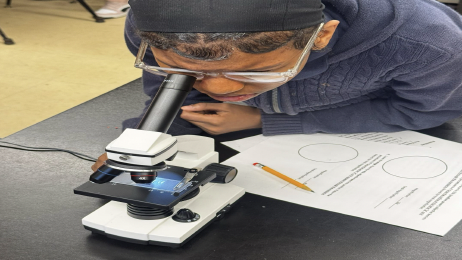
Students tackle a real-world problem: replacing petroleum-based plastics with biodegradable alternatives made from natural materials. They research how plastics fragment into microplastics that persist in soil and water, then design bioplastic formulas from starches and proteins, heating, mixing, and molding prototypes. Students test their bioplastics for strength, flexibility, and durability, and observe how microbes in soil and compost break them down over time.
Science Domains: Engineering, Technology & Applications of Science, Life Science, Physical Science
NGSS Standards: MS-ESS3-3, MS-ETS 1-3, MS-ETS 1-4, MS-LS2-3, MS-PS1
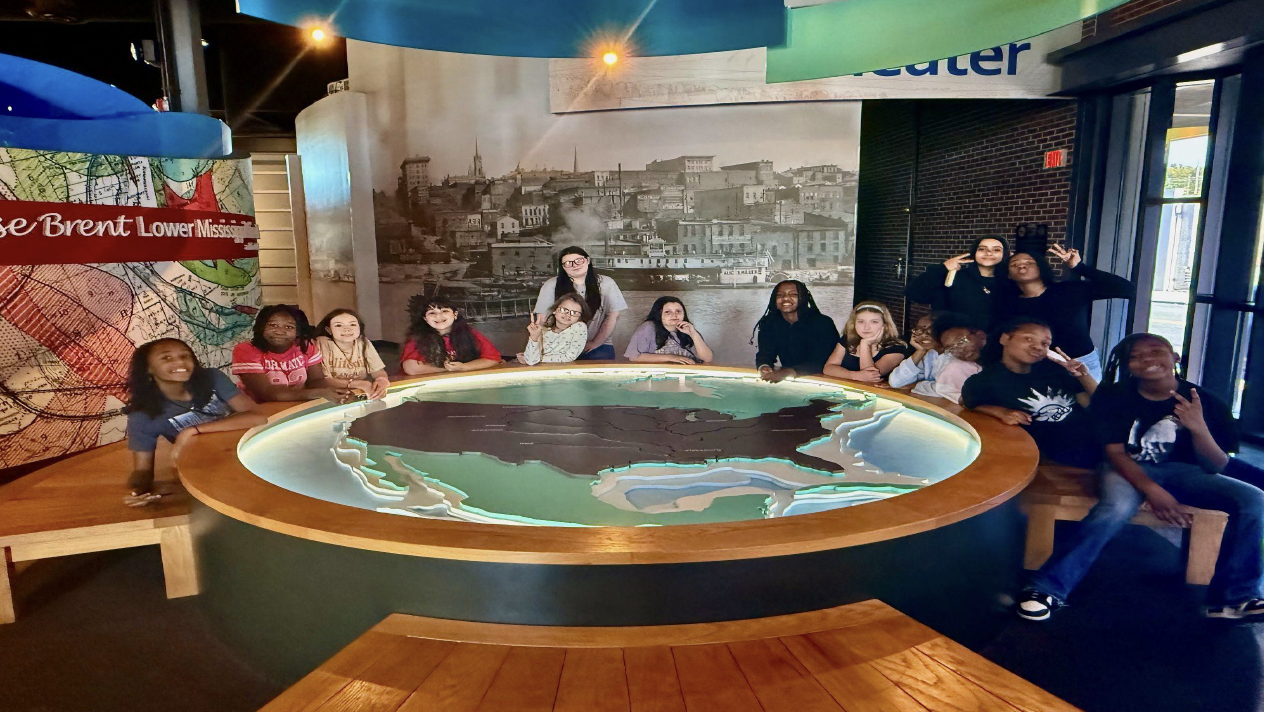
Sixth-grade students investigate how the Mississippi River has changed over time and what its water reveals about its health today. Anchored by the novel Minn of the Mississippi, students test river water samples, examine native macroinvertebrates, and compare their findings with partner classrooms studying rivers in other states. Field trips to the Lower Mississippi River Museum and Vicksburg National Military Park connect the river’s ecology to its history, and students translate their data into pour paintings and tapestries shared with families and educators.
Science Domains: Earth & Space Sciences
NGSS Standards: MS-ESS2, MS-ESS3-3, MS-LS2-1, MS-LS2-4
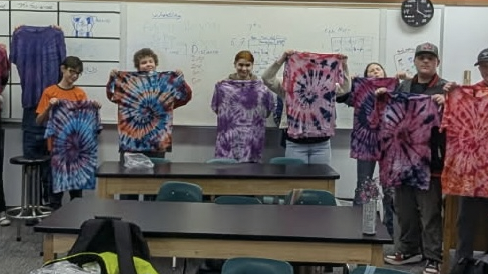
Students become a research team hired by a fictional T-shirt company, Root & Hue, to develop a line of natural plant-based fabric dyes. After exploring the history of natural pigments, students grow selected plants and investigate soil, photosynthesis, transpiration, and how plant pigments interact with different wavelengths of light. They use chromatography to separate plant pigments, explore conservation of mass in closed systems, and finally use their dyes to tie-dye T-shirts.
Science Domains: Life Science, Physical Science
NGSS Standards: MS-LS1-6, MS-PS1, MS-PS4-2
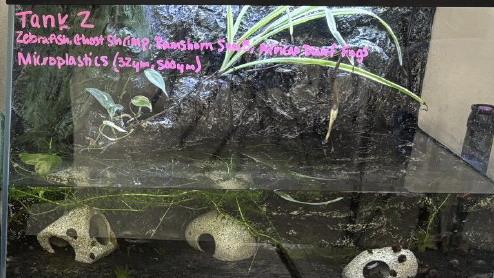
Students build two identical aquarium ecosystems modeled on Florida’s Indian River Lagoon, then add fluorescent microplastics to one tank to create a controlled experiment. Over the school year, they monitor water quality and organism behavior, discovering that while water chemistry stayed similar, zebrafish reproduced successfully only in the tank without microplastics. The tanks become a year-long storyline that connects lessons across the curriculum and builds student confidence in water testing, microscopy, and field research in the lagoon itself.
Science Domains: Earth & Space Sciences, Life Science
NGSS Standards: MS-ESS3-3, MS-LS1-5, MS-LS2-1, MS-LS2-4
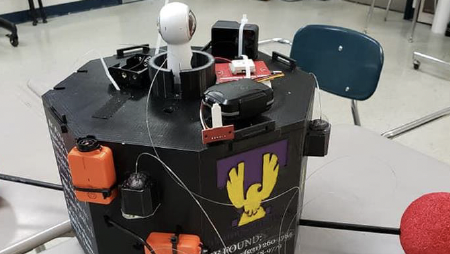
Students design, build, and launch instrumented high-altitude balloons that carry their experiments into the stratosphere. After a five-day project-based lab on the vocabulary and challenges of balloon flight, students plan payload layouts and design a power-management experiment to determine which batteries perform best in extreme cold and altitude. Flight data on altitude, temperature, speed, and climb rate are analyzed to improve each successive launch and are shared with Tennessee Technological University’s Electrical Engineering Department to support ongoing research.
Science Domains: Engineering, Technology & Applications of Science, Physical Science
NGSS Standards: MS-ETS 1-3, MS-ETS 1-4, MS-PS3
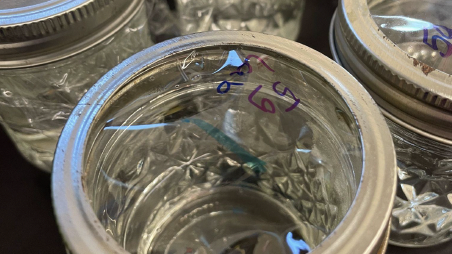
Students design and evaluate biodegradable plastic wrap made from plant-based materials, beginning with a campus litter survey that grounds the problem locally. Groups mix and cast bioplastic films, then test tensile strength, water permeability, biodegradability, and light-induced degradation, comparing results with conventional plastic wrap. Their findings spark independent science fair projects, such as exploring how composite films might improve performance while staying biodegradable.
Science Domains: Engineering, Technology & Applications of Science, Physical Science
NGSS Standards: ETS1.A-C, ETS1.B-C, PS1.A
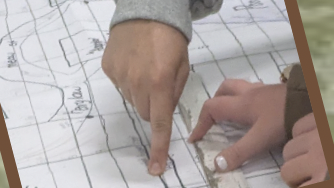
Inspired by the unsolved 1990 theft at Boston’s Isabella Stewart Gardner Museum, students become forensic investigators who analyze clues using real scientific techniques, from pigment chromatography to body-proportion analysis, and simulate escape routes using sensor-equipped robots. Students then flip roles, designing their own mini “Escape Room” mysteries for classmates, complete with original storylines, science-based puzzles, and a final code to unlock. The project blends critical thinking, storytelling, and engineering into a self-directed inquiry experience.
Science Domains: Engineering, Technology & Applications of Science, Physical Science
NGSS Standards: MS-ETS 1-3, MS-PS1
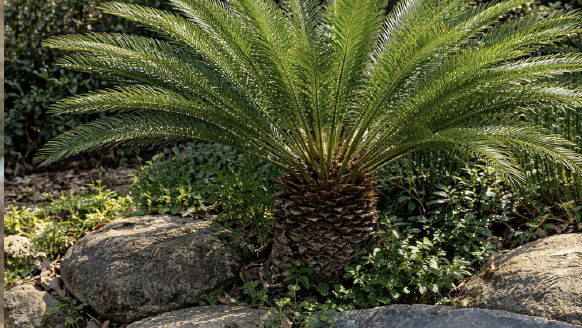
Students transform an outdoor campus space into a garden of “living fossils,” ancient plant lineages such as cycads, ginkgo, ferns, and horsetails that have endured for millions of years. Comparing these plants with fossil specimens, students explore what they reveal about Earth’s past environments and how some species have remained remarkably resilient. Students use environmental sensors to track light, temperature, and humidity, and use an indoor ecosystem model to investigate photosynthesis, gas exchange, and energy transfer.
Science Domains: Earth & Space Sciences, Life Science
NGSS Standards: MS-ESS2-1, MS-LS1-6, MS-LS2-1, MS-LS4
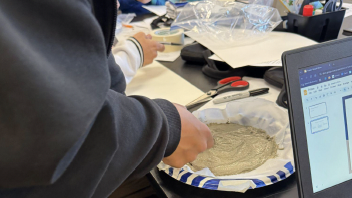
Introduction: Students design and test custom frisbees made from unconventional materials, including cement, to explore how material properties, density, and motion affect performance. Students manipulate mass and density, measure distance, time, and G-force, and calculate speed to compare their designs against a standard plastic frisbee. They then create videos or posters explaining how each of Newton’s three laws appeared during testing, supported by their own data.
Science Domains: Engineering, Technology & Applications of Science, Physical Science
NGSS Standards: MS-ETS1-1, MS-ETS1-2, MS-ETS1-3, MS-PS2-2

Build mini weather stations to learn about climate and skills needed for STEM-based careers
Science Domains: Earth & Space Sciences, Life Science
NGSS Standards: MS-LS1, MS-LS1-3, MS-LS2-2, SC.6.E.7.3, SC.6.E.7.6, SC.6.N.1.1

The queen has dropped a key into the castle moat, and the Oak Knoll Knights have to get it back. Students research, plan, and build autonomous underwater vehicles (AUVs) and remotely operated vehicles (ROVs) that they can steer, balance with ballast, and use to take photos underwater. After the rescue, students partner with the Virginia Institute of Marine Science, the Rappahannock Oyster Company, and a classroom on Tybee Island, Georgia, using their submersibles to study the declining oyster population in the Chesapeake Bay.
Science Domains: Life Science, Physical Science
NGSS Standards: MS-ESS1, MS-LS1, MS-LS1-3, MS-LS2-2, MS-PS1, MS-PS3-5, MS-PS4-2

Explore other planets to learn about local watersheds
Science Domains: Earth & Space Sciences
NGSS Standards: MS-ESS3-3

Research and plan an oyster reef restoration
Science Domains: Earth & Space Sciences, Life Science
NGSS Standards: HS-ESS3-3, HS-ESS3-6

Students use the engineering design process to solve real problems around their school. Each team gets a scenario, sketches a furniture design on isometric paper, turns it into a 3D model in Tinkercad, and prints a scaled prototype before building the full-size piece on a set budget. Finished products include a tiny food pantry, a laptop lost-and-found, courtyard seating, and recycling bins.
Science Domains: Engineering, Technology & Applications of Science, Physical Science
NGSS Standards: MS-ETS 1-3, MS-ETS 1-4, MS-ETS1-1, MS-ETS1-2

Seventh and eighth graders spend a school year making the Sun their central phenomenon. Using telescopes, they track the paths of the Sun and Moon to find cycles such as the seasons and moon phases. They use that data to predict sunrise, sunset, and eclipses, and they study how the Sun’s structure relates to light, energy, and matter. Everything comes together at the Solar STEM Festival, where students teach K–6 classmates on the day of the April 8, 2024 solar eclipse.
Science Domains: Earth & Space Sciences, Life Science
NGSS Standards: MS-ESS1, MS-ESS2, MS-LS2, MS-PS1, MS-PS2, MS-PS3, MS-PS4

Hurricane Ian badly damaged the mangroves around Sanibel Island, and sixth and seventh graders set out to help bring them back. Working with the Sanibel-Captiva Conservation Foundation, student pairs grow red mangrove propagules in substrates they choose. They then test how factors like fertilizer and algal blooms affect growth and record observations all year. At the end of the year, students plant their mangroves at a restoration site, helping the island recover and building their own resilience.
Science Domains: Earth & Space Sciences
NGSS Standards: SC.6.E.6.1, SC.6.E.7.4, SC.6.N.1.1, SC.6.N.6.3.4, SC.7.E.6.6

How can DNA can be used to determine what pathogenic bacteria are causing a food borne illness
Science Domains: Life Science
NGSS Standards: HS-LS1-1

Analyze a topographical map to choose a water source for multi-year tracking of chemical analysis
Science Domains: Earth & Space Sciences, Life Science
NGSS Standards: ESS2.C, ETS1.A-C, ETS1.B-C, LS2.A, LS2.C, LS4.D, PS1.A, PS1.B, PS3.D

Design and build a greenhouse to grow native plants for coastal restoration
Science Domains: Earth & Space Sciences, Life Science
NGSS Standards: MS-ETS1-4, MS-LS1-5, MS-LS2-1

Utilize food waste for effective carbon footprint reduction
Science Domains: Life Science
NGSS Standards: MS-LS1, MS-P1

Science Domains: Earth & Space Sciences, Engineering, Technology & Applications of Science
NGSS Standards: MS-ETS1-1, MS-ETS1-2, MS-ETS1-3, MS-ETS1-4, SC.8.E.5.10, SC.8.E.5.7

Using engineering design process to construct a bridge with given size limitations
Science Domains: Engineering, Technology & Applications of Science, Physical Science
NGSS Standards: MS-ETS1-1, MS-ETS1-2, MS-ETS1-3, MS-ETS1-4, MS-PS2-2

Designing wind turbines for maximum power output
Science Domains: Physical Science
NGSS Standards: MS-PS3-1, MS-PS3-5

Designing a greenhouse and building a hydroponic solution to address global hunger
Science Domains: Life Science, Physical Science
NGSS Standards: MS-LS1-6, MS-LS2-3, MS-PS3-3

Using Wood Ducks to study habitat management and wildlife interaction
Science Domains: Life Science
NGSS Standards: MS-LS1-5, MS-LS2-1, MS-LS2-4, MS-LS4-6

Designing a sustainable energy house for a specific biome.
Science Domains: Life Science, Physical Science
NGSS Standards: MS-LS2-2, MS-LS2-5, MS-PS3-3, MS-PS4-2

Using temperature, light, and g-force data from data loggers to develop a model representing how light, depth, substrate and stream depth impact microhabitats.
Science Domains: Life Science
NGSS Standards: MS-LS1-4, MS-LS1-5, MS-LS2-2, MS-LS2-5

Coding Ozobots and using stream tables to learn about the rock cycle and erosion.
Science Domains: Earth & Space Sciences
NGSS Standards: MS-ESS2-1, MS-ESS2-4, MS-ESS3-1

Using Edison Robotics technology to program robots using text and icon-based code.
Science Domains: Engineering, Technology & Applications of Science
NGSS Standards: MS-ETS1-1, MS-ETS1-2, MS-ETS1-3, MS-ETS1-4

3D printing for prosthetics, medical assistive devices and other engineered solutions to solve real-world challenges.
Science Domains: Engineering, Technology & Applications of Science, Physical Science
NGSS Standards: MS-ETS1-1, MS-LS1-3, MS-PS2-3

Development of an engineering unit to study wind and solar power as effective alternative sources of energy.
Science Domains: Engineering, Technology & Applications of Science, Physical Science
NGSS Standards: MS-ETS1-1, MS-ETS1-2, MS-ETS1-3, MS-ETS1-4, MS-PS3-5, MS-PS4-2

Demonstrate mastery of various coding programs through creating “steps” for a robot to dance.
Science Domains: Engineering, Technology & Applications of Science
NGSS Standards: MS-ETS1-1, MS-ETS1-2, MS-ETS1-3, MS-ETS1-4

Using Vex Robotics to build and code an Ozobot.
Science Domains: Engineering, Technology & Applications of Science
NGSS Standards: MS-ETS1-1, MS-ETS1-2, MS-ETS1-3, MS-ETS1-4

Explore the role of bees in our ecosystem and learn how to combat honeybee decline
Science Domains: Earth & Space Sciences, Life Science
NGSS Standards: MS-LS1-4, MS-LS1-5, MS-LS2-1

Designing and building a mid-powered rocket to safely launch a marshmallow astronaut in a space suit designed to ensure his survival.
Science Domains: Engineering, Technology & Applications of Science, Physical Science
NGSS Standards: MS-ETS1-4, MS-PS3-1

Measuring the impact of agricultural fertilizers on a local watershed.
Science Domains: Earth & Space Sciences, Life Science
NGSS Standards: MS-ESS3-3, MS-ESS3-4, MS-LS1-5

Investigate how sound waves transfer energy through matter as students develop and use models to explain why sound can travel through solids, liquids, and gases—but not through a vacuum. This STEM Short encourages students to make evidence-based claims while exploring the fundamental properties of mechanical waves.
Science Domains: Waves and their Applications in Technologies for Information Transfer
NGSS Standards: MS-PS4-1

Discover why gravity pulls all objects toward Earth and investigate what happens when air resistance is removed from the equation. Through engaging demonstrations, this STEM Short challenges students to make observations, analyze evidence, and explain why objects in free fall accelerate at the same rate regardless of their mass.
Science Domains: Forces and Interactions, Motion and Stability, Physical Science
NGSS Standards: MS-PS2-1, MS-PS2-2, MS-PS2-4

Explore the fascinating relationship between chemical reactions and energy as students investigate why some reactions absorb heat while others release it. Through hands-on observations and evidence-based reasoning, this STEM Short helps learners explain how energy is transferred during chemical changes.
Science Domains: Matter and Its Interactions
NGSS Standards: MS-PS1-4

Help students strengthen their data literacy by exploring how graphs reveal patterns, relationships, and scientific evidence. This STEM Short demonstrates how effective graphing supports data analysis, strengthens scientific explanations, and helps students communicate their findings with confidence.

Investigate the science of color as students explore how light interacts with different materials through reflection, absorption, and transmission. This STEM Short encourages learners to make observations, analyze evidence, and explain the phenomena behind the colors they see every day.
Science Domains: Physical Science
NGSS Standards: MS-PS4-2

Focused on structures in plants and sub-systems and sub-structures, this project takes place over months (rather than minutes or hours) and requires very minimal equipment.
Science Domains: Life Science
NGSS Standards: MS-LS1-2

Construct, use, and present arguments to support the claim that when the kinetic energy of an object changes energy is being transformed to or from that object. Students will also apply scientific principles to construct and test a device that either minimizes or maximizes thermal energy.
Science Domains: Earth & Space Sciences
NGSS Standards: MS-PS2-33, MS-PS3-5

Analyzing and interpreting data and arguing from evidence…using toothpaste.
Science Domains: Engineering, Technology & Applications of Science
NGSS Standards: MS-ETS1-3

The resources and tools necessary for teaching observation and measurement are not always available. Teach your students to build a microscope they can take into the field.

Collect data with magnets. This project encourages students to ask questions about data to determine the factors that impact electric and magnetic forces.
Science Domains: Physical Science
NGSS Standards: MS-PS2-3, MS-PS2-5

Students plan an investigation to provide evidence that the change in an object’s motion depends upon the forces acting on the object. They will also define criteria and constraints, make a systematic evaluation of different solutions, analyze data, and perform iterative testing – all in one video.
Science Domains: Earth & Space Sciences, Physical Science
NGSS Standards: MS-ETS1-4, MS-PS2-2

Enhance STEM teaching and learning with classroom-ready activities and hands-on science experiments
Engage students in authentic STEM experiences through participation in accessible programs and competitions
Develop new skills, stay current, and network with other STEM educators through award and professional development opportunities
